
TOTAL DURATION : 8 Days.
ROUTE / CIRCUIT : Dimapur – Bokajan – Merapani – Doyang – Wokha – Mukhami – Phishumi – Longkham – Ungma – Mokokchung – Wokha – Tesophenyu – Tseminyu – Botsa (Tuophema) – Kohima – Khonoma – Zakhama – Kisama – Kigwema – Jotsoma – Sechu (Zubza) – Medziphema – Chumukedima – Dimapur.
TOTAL DISTANCE : 600 Kms TOTAL EXPENDITURE : Rs 20,000 – 22,000 (For 2 Adults & 1 Child)
A Peak into this Mysterious ‘Naga’ Land

I had always longed to visit Nagaland. Scenic natural beauty, a love for their marvellous, inventive cuisine, and stories of their head-hunting forefathers, along with the particular customs of its various tribes – Ao, Angami, Konyak, Sema, Kuki, Kachari – all drew me there. Nagaland, by virtue of its location in the extreme east of the northeast, has a habit of popping up in public consciousness only when racked by incidents of militancy, and that has kept it largely off the radar of nosy cultural foragers. Information about most of this state is rather scant, and tourism brochures make such a great deal about the 16 major tribes that call this mountain-grit region home that you could be led to believe that you would be confronted by a horde of machete and spear wielding warriors adorned in amulets chiselled from bone and teeth and headgears fashioned from fur and hornbill feathers the moment you step off the aircraft at Dimapur. Of course, that’s not true anymore. Nagaland, or at least Kohima and Dimapur, is as unabashedly Western as the rest of India. The tribal costumes are reserved for special occasions like the Hornbill Festival, a ten-day long celebration of the primal, exotic and utterly unique tribal traditions. Which brings us to why I suddenly decided to head for Nagaland in the first place.

Held at Kisama Heritage Village, some 10-odd kms from Kohima, from December 1 to 10 every year since year 2000, the festival provides visitors the best introduction to the fast-fading lifestyles and traditions of these fiercely independent former head-hunters. The setting comes complete with traditional stilt-houses and totems with Naga warriors, hornbills, crocodiles and tigers carved on them. There are even animal trophies dangling from the walls of the huts, and then there are the warriors and pretty ladies themselves, decked up in psychedelic colours dancing the most traditional dances. Since its inception more than 20 years ago, this festival has brought about radical changes in the tourism scenario of the state. A visitor gets the opportunity to catch a ring side view of all Naga tribes, their culture and distinctiveness at one place. With all of Nagaland’s tribes coming together for it, Hornbill Festival is a welcome assault on the senses. Dance and music performances take centre-stage, while the various tribal morungs at the Kisama Heritage Village overflow with good food and drink. But beyond the performances, there are sleepy villages to explore too. The weather during this time of the year is lovely, and it helps that there are numerous comforting and vibrant campsites, which pop-up at the time of Festival, to retire to each evening.
The festivals of Nagaland are the main reason around which most tourists plan their Nagaland tours – no wonder it’s called ‘The Land of Festivals’.

Enter into the Region of Head-Hunters
Our flight was about to land at the only airport of the state in Dimapur, and the sight through the tiny window of the aircraft was truly mesmerising. Most of Nagaland is covered with hills and mountains, and these hills suddenly rise from the Brahmaputra valley which was a reckoning sight from up there. Dimapur is Nagaland’s biggest and most industrialised city. We reached Dimapur and picked up of what was going to be our ‘mode of transport’ for next 10-odd days in Nagaland – a well-maintained, sturdy looking XUV-500 belonging to a dear colleague from my Regiment. We hit what’s marked as “NH-129” on the map towards Wokha, but few kms into the journey, and the so-called National Highways in this part of the country turn into worse conditions than even internal village roads in other parts of India. The lack of infrastructure development in north eastern states was clearly on the display with the conditions of highways here. I received a good suggestion from a local passerby, to take the internal village roads instead, which was a delightful stretch of Assam countryside, with vase expanse of green paddy fields interspersed with tiny little lily ponds, and domestic animal stock of goats, ducks, hens in abundance, flocking the surroundings of their trademark bamboo hutments. We crossed Doyang River at Lotha Bridge, and entered the huge traditional ‘Wokha Gate’ welcomed us at Vankhosung to take us to our place for stay that night – The Hammock Resort. It is located right on the Wokha-Mokokchung road and is one of the best options for people travelling further ahead to Mokokchung.

The district of Lotha Nagas is a land of beautiful mountain ranges and rivers. Wokha town itself is located at the Wokha Mountain. No matter which hill you are on or which valley you are trekking here, you are sure to experience the vibrant landscapes carpeted with colourful flowers and orchards. After savouring on some authentic Pork cooked Lotha style (Wokosonkong Han) along with Spicy Banana Flower Chutney (Yuthi Machihan), we stepped out in the still dark night and a zillion stars were waiting to welcome us into the folds of such a starlit night, as never seen before. It was one of those rare occasions in life when you feel a pure, unrestrained joy to be alive, right here, right now. The blissful night gave way to a bright sunny day and we were in high spirits, exhilarated to be driving towards Mokokchung. Halfway into Wokha – Mokochung stretch and the scenery takes a drastically beautiful turn and a kaleidoscope of autumn tree colours are thrown on your eyes from mauve and pink to red and yellow. These were some of the best sights you could come across in entire of Nagaland.

Ungma Model Village was our next stop-over, it is the second largest village in Nagaland and located just 3 kms short of Mokokchung town. It is said that the entire Ao Tribe founded this village when they first entered the land from their ancestral locations. The rich Ao traditions are zealously guarded and practiced by the villagers here even today. Later we entered the narrow busy roads of Mokokchung town and took a while to trace the route to our local homestay here. The charming Ao Tribe couple, Dr & Mrs Longchar, who have owned and managed this lovely homestay called ‘Abode in the Mountains’ for two years now, checked us into their beautiful home and into our room. In the evening, Dr Longchar took us into his ‘Secret Chamber’ next to the kitchen where he had all sorts of meat hanging on top of the entire room, being smoked in a traditional Naga manner by the fire from below. To our delight, the dinner menu included just that – the Ao tribe trademark dish of Smoked Pork with Anishi (Yam Paste & Red Chillies) along with Sticky Rice.

History Beckons in the State Capital

With some everlasting memories, we bid adieu to the wonderful couple and headed to the state capital Kohima.
Nagaland’s agreeable capital Kohima is painted across a series of forested ridges and hilltops like spangled topping on a vast pistachio sundae. Although originally an Angami Naga homeland, Kohima is now a tapestry of all Naga tribes because of its administrative status. The Catholic Cathedral on Aradurah Hill, with its red-tiled roof, is the city’s most prominent landmark. It’s supposed to be the largest cathedral in the North East and has a 16-feet high carved wood crucifix which is one of Asia’s largest crosses. The other big tourist draws here are the World War II Memorial, dedicated to the brave Naga soldiers and the immaculate war cemetery located in serene environs contains graves of 1200 British and Indian soldiers killed fighting the Japanese during an intense 64-day WW-II battle which put Kohima on the world map.

Arrival in the chaotic state capital was soon forgotten when we landed at the ‘Kohima Night Carnival’ on its main street – it appeared that the entire town and beyond has congregated at one narrow part of this Kohima street for a big party. There was live bands performing, comic and other superhero characters in a Halloween form all over, neon light glasses, horns, headgears being sold and stalls selling local delicacies, meat of every kind and rural Naga liquor being given away as free samples. We tried and experimented all sorts of local flavours, from pork intestines to blood sausages and from dog meat to beef BBQ. Much later when we drove back to our BRO guest room after a vibrant night of local flavours of all kinds, the view from the windows of our guest room was simply unbelievable. The night had gone mad with stars and in front of us, spread over several hills and lit like perpetual Diwali, was Kohima – it was beautiful.
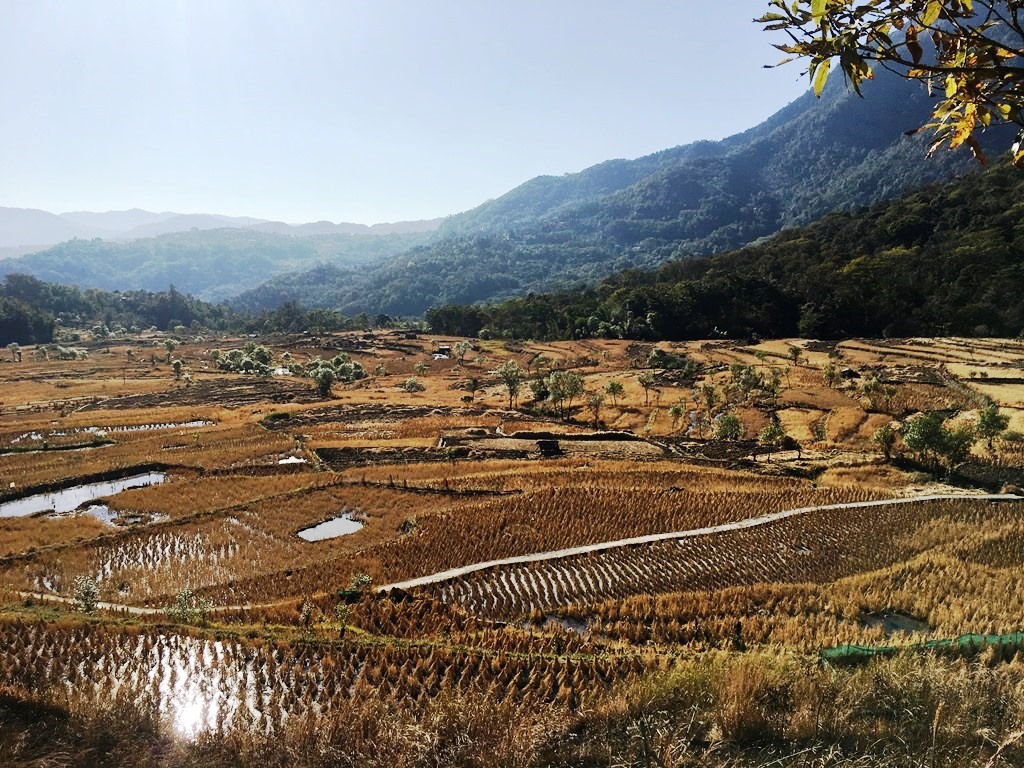
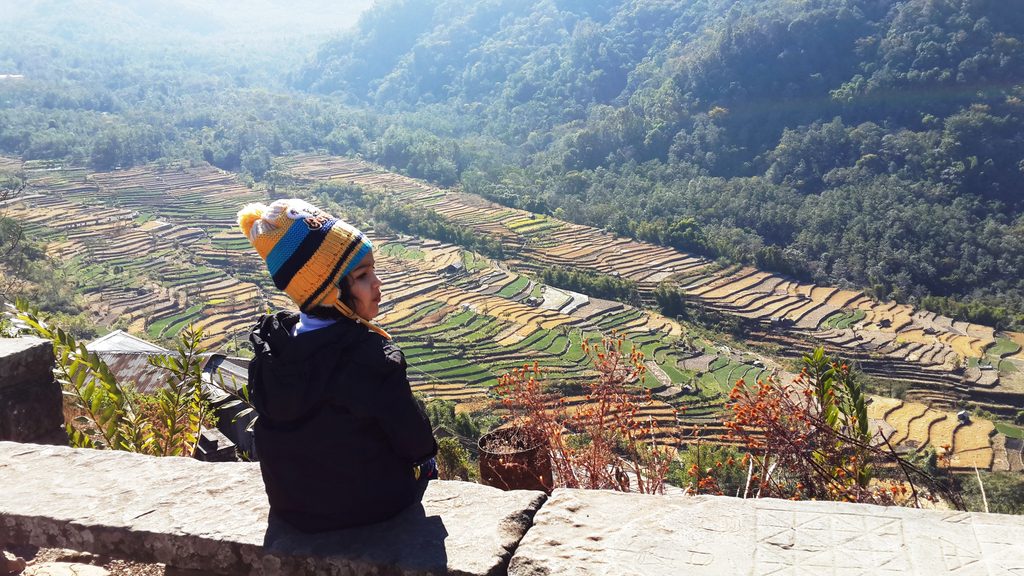
Next day morning excursion found me on a lushly forested drive, heading deep into the hills to Khonoma, the ‘First Green Village of Asia’. This historic Angami-Naga village was twice besieged by Brits but now sits idyllically amid flowers and pomelo trees, squash gourd vines, and megaliths, graves and dahu circles. The centre of the hamlet is dominated by the tehuba, a platform made of stone, where the village council metes out justice. As I walked up the steep paths of this 700-year-old village, large swathes of terraced fields sprung into view. We were witnessing nature’s pristine beauty in the form of its alder trees, terraces carved out of its hilly slopes and rare variety of flora and fauna. Our local guide took to one of these homestays where a local lady had rustled up the tastiest meal for us.
We had chicken for lunch and lots of rice beer that was served in a bottomless bamboo stalk, along with copious quantities of wild apple wine. Finally we drove towards our Zakhama where the campsite was waiting for us, and the majestic view of Japfu peak came into horizon. Right behind the Japfu Peak lies the ‘famed’ Dzukou Valley, watered by meandering streams which sometimes freeze in the winters. In spring, the valley is full of lilies and rhododendrons – no wonder it’s called the ‘Eastern Valley of Flowers’.


Camping at Zakhama Village with Challo Hoppo

The ‘Yedhika Campsite’ at Zakhama village, enjoys a forest setting under the gentle gaze of Nagaland’s mountain ranges, far from the din of Kohima. This lovely and picturesque camp was our abode for next four days, which was being run by this extremely warm and hospitable brother-sister duo from nearby Zakhama village. Along with his sister, George played perfect camp host, chatting up with guests, offering local insights, recommending excursions and generally being nice and reassuring. As soon as we walked out of our car and walked into the big wooden gate, the entire set-up gave a feeling of fun and frolic, and more importantly, acceptance. The entire campsite was into three or four levels in a manner of step-cultivation trademark to this hilly region, with common hygienic bathrooms located separately. We walked down to the third level where our cute little tent was waiting right at the edge, last one of the series of tents, naturally having the best of the views. In the evenings, there would be bonfires, rice beer and endless conversation – the time-honoured way of building bonds. We decided to take it easy and not make this like an organised package tour.

If the blue sky by day was to die for, the night sky was another beast, billowing with stars and galaxies. The daytime nip in the air had turned into something deliciously cold. The staff had set a crackling fire going same night, around which an interesting cast of characters had congregated. With the ‘Young Brigade’ of Challo Hoppo Tour Company, mainly from Guwahati and around being the perfect hosts, we knew it’s going to be fun evening. They also offered us some surprisingly tasty local rice beer, or Zutho, as they call it locally, while rest of the crowd was delighted when I pulled out our dear ‘Fauji Old Monk’. The dinner spread was extra-special with the staple pork, greens and chicken aan-soi (chicken stew thickened with ground rice), everything was smoky and incredibly fresh. The rest of the night went by enjoying some great soulful music and good company.

The next couple of days, we headed to Hornbill Festival in the day time and explored the local rural surroundings in the evenings. Two days of the fascinating Hornbill Festival was enough for the senses and our comfort level. So breaking the routine, we decided to get away from the brochure bit about Nagaland and find ourselves a place that was not ‘make-believe’. That’s when the local brother-sister duo of nearby Zakhama village took us to show around their own village. The warren of lanes and bye-lanes are completely disorienting and the village looked unlike any other in the country. Massive
Mithun
faces carved into the walls of the wooden houses, the brightly patterned shawls, the wild and rugged country surrounding the cluster of houses, the whirls of paddy fields splashing down the mountainsides, and colourfully-dressed women laden with necklaces. Ridge after ridge receding into the mist, valley after valley plunging into nowhere, interrupted with classical antiquity by a sprinkling of houses in the distance. When we finally finished our ‘leisurely’ walk, we were too exhausted even to open the zip of our tent also.

Hornbill Festival : A Cultural Extravaganza

Nagaland’s biggest annual event, the
Hornbill Festival, is held at Kisama Heritage Village where various Naga tribes converge for a colourful week-long cultural, sporting and costumed dance celebration. This is the best opportunity to see Naga tribal ‘warriors’ in their traditional garb. The setting of Nagaland’s most famous festival, Kisama Heritage Village, is in form of an open-air museum. Its main arena sees folk dance and music performances all day, while the morungs, traditional tribal homes of the tribes, are where tribal costums, costumes and cuisines are showcased. The Naga wrestling championship is also held here. All the tribes here showcase their traditional finery, even the most urban of the townfolk sports a tribal necklace. They wear their shawls, necklaces, traditional woven hats, the men especially conspicuous in their stashes, which are tied across their chests from shoulder to waist.
After checking out almost all the 16 Tribals Huts, we settled down at the central main festival arena as the
Rengma tribe group from nearby Kohima area walked in to perform. The dancing, chanting and singing commenced in a great fan-fair atmosphere. The men sported hornbill feathers, woven red sashes, knives with furry tails, spears and bells which are attached to their backs. The women dance more sedately, sporting armbands, belts, waistbands around their shawl-skirts, headbands, intricate earings and feathers. Afterwards, we headed to the Kuki tribe hut for a feast of luscious pork and rice, the richness of which was meant to be cut by the accompanying passion fruit leaves and washed down by sweet Zutho.
On one of the our day’s visits to the festival village, I was nicely sitting basking the sun with my bamboo cup of Corn Tea (or what’s also known as Job’s Tears Tea), out from nowhere came out these fierce Konyaks – The village warriors dressed in their finery, elderly men with tattoos on their wizened faces, beaded chokers around their necks and little bronze heads that symbolise how many enemy skulls the warrior has claimed. They made quite a spectacle marching up the narrow lane, spears in hand. They made quite a spectacle, but I was more concentrated on my freshly barbequed dark red sausage which was actually cooked in pig’s blood. Then I hit the multi-meat Chakhesang buffet, the festival’s best – much to the discomfort of Deenaz & Arianna. But I am all for trying everything laid out on the table at community feasts, as an appreciative audience cheered me on between sucking bits of meat out of snails, biting into crunchy bugs and attacking slabs of pork-meat that had blood as flavouring. By the end of lunch, I had polished off a fair number of stewed dog-meat, fried frog legs, steamed hornets larvae, silkworm curry and a myriad of other bugs fried in their own fat.

Nagaland is a Visual Delight

Nagaland is a land engulfed in mystery, inhabited by vibrant people zealously guarding their culture – dancers, warriors, head-hunters; mountains, valleys, forests – all these form the portrait of Nagaland the moment the word is uttered. From extreme mystery to hosting a globally famous cultural festival, Nagaland has come a long way over the years and etched a name for itself in the world’s tourist destination map. Why more travellers don’t head out to Nagaland has to be one of the enduring mysteries of our time. Nagaland is blessed with extraordinary natural beauty and the food is to die for. More importantly, they don’t go around collecting heads anymore.
It’s so ironic. We urbanised, overcrowded city-dwellers dream of these far-fetched remote places and travel to even the far side of the world to reach them, to get away, to gaze at unpolluted night skies, to be free of mobile phones, email, traffic, noise, crowds. For many of us these dwindling pockets of wilderness are earthly paradises, precious fragments of disappearing world. Yet for the people who live here the wilderness is there to be tilled, planted, fished and hunted. Their lives are about food, water and shelter – the primal aspects of human survival. Their strongest and most famed asset is their culture and customs which the Nagas hold very dearly and close to their heart. Despite the lack of infrastructure and despite the development, it is still the most visually seductive place I have seen. Their traditions, I hope, would endure for a long time to come.
Great write up sir..safe travels..keep blogging
Ashish, You had described in way that I am attracted to food and events\festivals.
Hope I get chance to visit North East.
Keep travelling ..Keep blogging..
Extremely wonderful ✍️ up which took me through the picturesque scenes of rivers, valleys,mountains, forest and the villages of Mizoram and Nagaland. Exposed me to the rich and cultural heritage of this region. The serene beauty of these regions as pictured in this write up is really amazing. Every point of travel �� is enjoyed to the fullest ��.
Hat's off to the travellers and waiting to read and reach such destinations through them in future also.
Dr DI Narkhede, Prof
College of Military Engineering
Pune 31, India
Amazing Col Saab . I envy you always whenever I read or see the pictures of your adventures , to be honest all these all are part of my bucket list . Next time we shall all plan a trip together . Keep inspiring us and stay safe and enjoy.